Analysis of Linear search (Worst, Average and Best Cases)
suggest changeWe can have three cases to analyze an algorithm:
- Worst Case
- Average Case
- Best Case
#include <stdio.h>
// Linearly search x in arr[].  If x is present then return the index,

// otherwise return -1
int search(int arr[], int n, int x)
{
    int i;
    for (i=0; i<n; i++)
    {
        if (arr[i] == x)
         return i;
    }

    return -1;
}
/* Driver program to test above functions*/

int main()
{
    int arr[] = {1, 10, 30, 15};
    int x = 30;
    int n = sizeof(arr)/sizeof(arr[0]);
    printf("%d is present at index %d", x, search(arr, n, x));
    getchar();
    return 0;
}
Worst Case Analysis (Usually Done)
In the worst case analysis, we calculate upper bound on running time of an algorithm. We must know the case that causes maximum number of operations to be executed. For Linear Search, the worst case happens when the element to be searched (x in the above code) is not present in the array. When x is not present, search() compares it with every element of arr one by one. Therefore, the worst-case time complexity of linear search is Θ(n).
Average Case Analysis (Sometimes done)
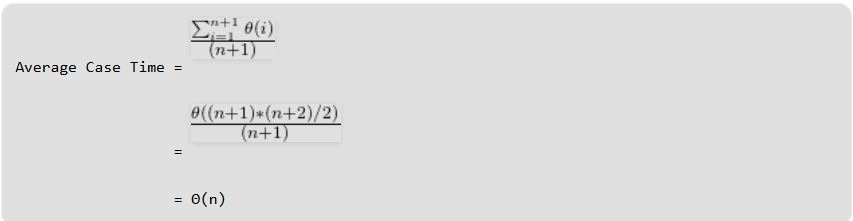
In average case analysis, we take all possible inputs and calculate computing time for all of the inputs. Sum all the calculated values and divide the sum by total number of inputs. We must know (or predict) distribution of cases. For the linear search problem, let us assume that all cases are uniformly distributed (including the case of x not being present in array). So we sum all the cases and divide the sum by (n+1). Following is the value of average case time complexity.
Best Case Analysis (Bogus)
In the best-case analysis, we calculate the running time on an input that causes the fewest operations. For linear search, the best case occurs when x is at the first location. The number of operations is constant (not dependent on n), so the best-case time complexity is Θ(1). Most of the time we analyze the worst case, because that is an upper bound on the running time for every input. Average-case analysis is harder: we must know, or predict, the distribution of inputs. Best-case analysis alone is easy to misuse. It does not say what happens on other inputs, and in the worst case an algorithm may take years to run.
For some algorithms, all the cases are asymptotically same, i.e., there are no worst and best cases. For example, Merge Sort. Merge Sort does Θ(nLogn) operations in all cases. Most of the other sorting algorithms have worst and best cases. For example, in the typical implementation of Quick Sort (where pivot is chosen as a corner element), the worst occurs when the input array is already sorted and the best case occurs when the pivot elements always divide the array in two halves. For insertion sort, the worst case occurs when the array is reverse sorted and the best case occurs when the array is sorted in the same order as output.