Big-Omega Notation
suggest changeΩ-notation is used for asymptotic lower bound.
Formal definition
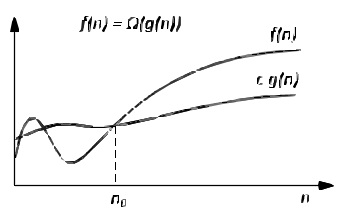
Let f(n) and g(n) be two functions defined on the set of the positive real numbers. We write f(n) = Ω(g(n)) if there are positive constants c and n0 such that:
0 ≤ c g(n) ≤ f(n) for all n ≥ n0.
Notes
f(n) = Ω(g(n)) means that f(n) grows asymptotically no slower than g(n). We use Ω(g(n)) when the analysis is not tight enough to state Θ(g(n)).
From the definitions of the notations, the following theorem follows:
For any two functions f(n) and g(n), f(n) = Ө(g(n)) if and only if f(n) = O(g(n)) and f(n) = Ω(g(n)).
Graphically Ω-notation may be represented as follows:
For example, let f(n) = 3n^2 + 5n - 4. Then f(n) = Ω(n^2). It is also correct that f(n) = Ω(n), or even f(n) = Ω(1).
Another example is a perfect-matching algorithm: if the number of vertices is odd, output “No Perfect Matching”; otherwise try all possible matchings.
We would like to say the algorithm requires exponential time but in fact you cannot prove a Ω(n^2) lower bound using the usual definition of Ω since the algorithm runs in linear time for n odd. We should instead define f(n)=Ω(g(n)) by saying for some constant c>0, f(n)≥ c g(n) for infinitely many n. This gives a nice correspondence between upper and lower bounds: f(n)=Ω(g(n)) iff f(n) != o(g(n)).
References
Formal definition and theorem are taken from the book “Thomas H. Cormen, Charles E. Leiserson, Ronald L. Rivest, Clifford Stein. Introduction to Algorithms”.